• Skip to primary navigation
  • Skip to main content

Experts in Excess

Your guide to sustainability.

  • Home
  • About
  • Contact
  • Resources
    • What I Follow – Blogs, Newsletters, & Podcasts
    • Tools I Use
    • Where I Shop
    • Website
You are here: Home / Archives for Sustainability

Sustainability

Sustainability Jobs

November 27, 2018 by mwabbott Leave a Comment

How do you get a job in sustainability?

One of the most common questions I hear is “How do you get a job in sustainability?” There are a lot more sustainability jobs than when I joined the field in 2008. This doesn’t mean it is any less challenging to find the right role for you;)

I follow a variety of feeds (LinkedIn, RSS, email, etc.) and review annual reports to try to keep a pulse on the whole sustainability job market. Below are my go-to resources for sustainability jobs.

Sustainability Job Feeds I follow: 

  1. Ed’s Clean Energy & Sustainability Job List – Ed Carley sends sustainability job postings to your inbox every Sunday. The list is helpfully sorted by career phase. 
  2. Green Jobs Network – I love GJN’s monthly(?) email newsletter. Jobs are listed by location (including remote) spanning all career phases. You can also stay up to date by visiting their webpage (RSS)
    • LinkedIn
    • Twitter @GreenJobs
    • Facebook
  3. Reconsidered Jobs – I am newer to this site and enjoy the content of their almost weekly email newsletter. The job site is well managed and more international than the other listings
    • LinkedIn
    • Twitter @reconsiderco
  4. Weinreb Group – This is the most active listing that I know of (and kudos on some great SEO!). While I have heard great things about their recruitment services, I don’t have any first-hand experience.
    • LinkedIn
    • Twitter @SustainableJobs
    • Facebook
  5. Urban Sustainability Director’s Network – good for government and nonprofit partner listings.
    • Twitter @theUSDN
    • Facebook

Sustainability Career Coaching

Coaching is a topic unto itself and I would not be where I am at without it. Here are two great resources:

  1. Walk of Life Coaching – Shannon Houde and her team are dialed into the sustainability career space. I am a very happy client of both their coursework and direct coaching, it is some of the best money I have spent.
    • LinkedIn
    • Twitter @walkoflifecoach
    • Facebook
  2. Sustainable Career Pathways – Trish Kenlon and I both call Park City, UT home. She’s consistently generous with her network.
    • LinkedIn
    • Twitter @SustainableCP
    • Facebook

Bonus: Find Your Dream Job – I’m a big Ramit Sethi fan, while I haven’t purchased this course from I have purchased seven(!) other courses from I Will Teach You To Be Rich.

I use my RSS reader (Feedly) to track job feeds. I’ve also added this content permanently to my resources page.

Happy hunting!

Filed Under: Coaching, Jobs, Sustainability

Diffusion of Innovations

by mwabbott Leave a Comment

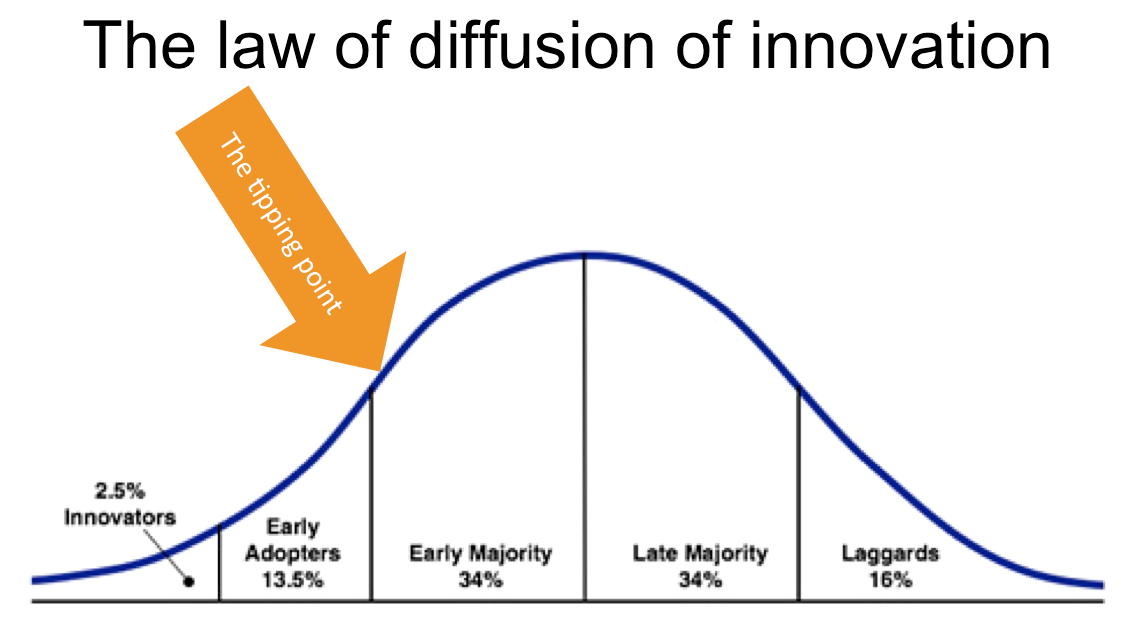
Simon Sinek Presents: The “Law” of Diffusion of Innovations

I hate seeing a video embedded in a PowerPoint presentation. PowerPoint already maintains a debatable role in “good” presentations and embedding a video screams “help me kill time.”

I say this based on personal experience. My first attempt was in high school and the minutes I was hoping the video would burn was consumed by technical failures. I gave it a second attempt in college assuming that faster internet and better AV would successfully bridge my lack of content. Since then, I’ve made it a rule that unless a video presentation is either the product or requested, no videos allowed.

All that said, I think I have seen Simon Sinek’s TEDx Talk, How Great Leaders Inspire Action, embedded in paid presentations at least three times. With over 40,000,000 views it has struck a chord, and there is a ton of value in his 18-minute presentation. While a lot of themes and concepts work in concert one of the most critical thoughts was the  Diffusion of Innovations.

Diffusion of Innovations

I agree with Wikipedia that this is a theory, not a law. I’m also willing to bet that you’ve been introduced to this general concept in one form or another. A class on statistics, conversations about bell curves, or just anecdotally. Diffusion of Innovations matches how we presume the world works and we see it all the time. Early adopters of electric vehicles, lifestyles, fads, etc. and, conversely, laggards when it comes to cell phones, food, style, etc.

Why the Diffusion of Innovations Matters

Where the light bulb finally went on for me is that this is how you should approach a market(!). I don’t doubt that some of you with better marketing backgrounds are way ahead of me… It took me grad-level marketing courses, and three viewings of Simon Sinek’s How Great Leaders Inspire Action to make this leap:)

How to use the Theory of Diffusion of Innovations: LEDs (again!)

The specific problem I was trying to solve was: How do you market energy efficiency to consumers?

Energy efficiency is a broad topic. Some of the categories are:

  • Lighting
  • Heating, Ventilation, & Air Conditioning (HVAC)
  • Appliances
  • Behavior
  • Building Science (Design, Materials, Air Sealing, Insulation, etc.)
  • So much more…

Each category contains numerous full-time professions(!). Where do you start?

When thinking about energy efficiency and specifically seeing results at the meter, we wanted a few things:

  1. Low-barrier to entry – Is it the action perceived as easy and affordable?
  2. Compliance – Will the customer follow through?
  3. A sense of success – Does the doer feel successful? Will this action help build confidence?
  4. Trust/leverage – Does the outcome build a relationship between the consumer and the provider (me)?
  5. Introduction to the next step – How are we building a journey we can travel together?

Knowing this, we chose LED light bulbs as a starting point. To spell out the logic:

  1. Low-barrier to entry – Is it the action perceived as easy and affordable?
    1. Yes. LEDs are cheap and relatively easy to find.
  2. Compliance – Will the customer follow through?
    1. Yes. LEDs are no more difficult to install than other bulbs.
  3. A sense of success – Does the doer feel successful? Will this action help build confidence?
    1. Yes(?). I certainly felt this way. Most people notice changes in light color and quality, even if they do a good job matching bulbs. Longer-term, it’s a safe bet that if you change the majority of light bulbs, you’ll see your electricity bill go down by at least 10%.
  4. Trust/leverage – Does the outcome build a relationship between the consumer and the provider (me)?
    1. Yes. We helped this along by making a specific tool to help the installation process (1-page info sheet to help make a shopping list and record where you’re changing bulbs along with a list of local retailers) and recommended highly-rated bulbs. This is a variation on what Ramit Sethi calls the “Briefcase Technique.” We did +80% of the work in advance to help set the consumer up for success.
  5. Introduction to the next step – How are we building a journey we can travel together?
    1. Sort of. We conditioned our consumers to make small changes. Most consumers were either passively or actively aware that there are lots of things you can do for energy efficiency.

Recentering on Diffusion of Innovation. LEDs were already on their Diffusion of Innovation curve internationally. The history of LEDs dates back to 1962, and we’ve seen them applied in many ways throughout our lives. Big picture, we’re talking about an established technology with a multitude of applications internationally.

The micro-market of LEDs our team was focusing on was installing LED lighting in residential and commercial buildings. At the time (2014), LEDs light bulbs were finally at a place where they made economic sense and could outperform their competitors, CFL, and incandescent bulbs. More specifically, our goal was to normalize LED light bulbs in peoples homes. To help them migrate from their habit of purchasing and installing CFLs and incandescent bulbs.

Diffusion of Innovations: Target Markets & Focus

The gift of the Diffusion of Innovation is that it helped us focus on the early adopters (~14% of the population) and the early majority (~34% of the population). We started asking ourselves what we could to grease the skids? What were the steps we could take to make it as easy as possible for these two populations to adopt?

I am going to continue to focus on the mindset and strategy and share the specific tactics we used in another post.

Diffusion of Innovation helped us focus. We could make and test assumptions about a specific subpopulation. This correlates well with the frequent entrepreneurship/marketing advice: “find your niche.” Which I interpret to mean, find your toehold and build from there.

More importantly, this mindset scales. We applied it over and over again for each program we launched. LEDs, smart thermostats, rooftop solar PV, behavior change, and even whole home weatherization.

Fundamentally, I see Diffusion of Innovation as an important mental model for establishing a new normal and segmenting your market. Establishing a new normal is critically important to sustainability work. The bulk of sustainability work is change management/culture change/midwifery. Constantly birthing a new future, over-and-over-and-over for everyone you work with. A big part of establishing a “new” normal is communicating as if it is normal. This is a challenge for you. How do you communicate that what you’re proposing is “normal.” Not a pilot. Not a test. Not a hypothetical. Normal.


Filed Under: Behavior Change, Marketing, Messaging, Sustainability

Acronyms & Jargon: How to Be Heard

by mwabbott Leave a Comment

In 2015 I worked for a new mayor, and one of his first “executive orders” was an odd one. We couldn’t use acronyms anymore. He jokingly called it the AFA Policy or Another Fucking Acronym Policy. Making it a joke allowed him to enforce it with a wink and a smile (which has its own genius). The AFA Policy went to work right away. Anything we wrote had to have all of the acronyms listed and defined. For the first time in years, full names of various projects, programs, and groups were uttered out loud. Acronyms are a form of jargon, and they’re not always a good thing. I want to think that the government became just slightly more approachable.

Starting Here, Right Here: Experts in Excess, AKA e-in-e

I’ve made some solid contributions to the world of acronyms. Starting on this very page, I contract “Experts in Excess” to “e-in-e” because its brevity and aesthetic makes me happy:) Does “e-in-e” mean anything to you? Probably not. Does it make what I’m trying to do here any more approachable or clear? Definitely not. If there is any penance for making a new acronym, it’s hearing people butcher them…

Acronyms: Apathy and Approachability

Why do we use jargon and acronyms? It’s a quick way to figure out who you’re talking to and what they know. It also saves time and space. More basically, we contract businesses, team names, projects, and processes to acronyms because we’re cognitive misers (which is the polite way to say we’re lazy). Our brains take a lot of energy to run, and historically, calories have been an inconsistent resource. There is a ton of great research on habits, willpower, decision making, etc., and their cognitive impacts over time. While we may not have evolved to create and use acronyms, we definitely have a predisposition towards them.

Why is this a problem? Jargon and acronyms alienate your audience. Whatever short-term boost in ego, confidence, or exclusivity, you experience being robbed from the person you’re communicating with. Precious attention is diverted from your message into translating your jargon. Acronyms and jargon confuse and bore your customers, partners, friends, and especially your partner:) There is a huge cost of being unapproachable.

Fixing the Jargon & Acronym Problem

The genius in Mayor Thomas’s Another Fucking Acronym Policy was that it tore down a wall in our communication. After decades of comfortably letting our culture’s language drift into the realm of unapproachable, we had to change, and we had to do it fast. We had to change the way we wrote, we had to change the way we talked, and I’d like to think we had to change the way we thought. The government should be customer-centric, and I’d bet you’re trying to be customer-centric as well. So what do you do:

  • Listen to yourself and correct yourself
    • Your friends or partner can help keep you accountable
  • Review your published materials
    • Get rid of jargon or acronyms that don’t clearly help your audience
    • If you don’t know, your audience definitely doesn’t, so get rid of it
    • Can’t tell? I’m 100% guilty of this. Ask someone to read through your materials
  • Your word processor’s ‘Find and Replace’ tool is your friend
  • Double-check your emails

I’ve been working on this for a couple of years now and I’m still slipping up:)

Filed Under: Marketing, Messaging, Sustainability Tagged With: acronyms, communication, jargon

Features vs. Benefits in Sustainability

by mwabbott Leave a Comment

The Origin of Features vs. Benefits: Influence

Influence is one of the most critical skills you can learn as a sustainability professional. Influence speaks directly to features vs. benefits. Influence is a broad field, but its focus is on human psychology and behavior. There is a ton of academic research on this topic and some great authors to explore. Where the rubber meets the road is in marketing and sales.

I know, I know. Even with an MBA, it’s taken me years to see marketing as more than advertising and sales as more than a stereotype. You’ve probably got an image of a sleazy salesperson in your head right now! Guess what? Sustainability professionals are pretty easy to stereotype too:)

But really. Every single day the skills, strategies, and tactics of sales and marketing professionals influence you. Just take a second and look around you. I like to think of myself as something of a minimalist, and I’m surrounded! Beyond consumerism, my ideas are shaped by talented sales and marketing professionals.

Influence is a powerful skill set, and it will make your work better. Understanding features vs. benefits are one of the first steps in improving your influence.

Features vs. Benefits

One of the most basic mindsets is communicating benefits ahead of features. In the business publishing industrial complex this is called “features vs. benefits” (these are your keywords to Google a wealth of articles).  

Features are factual statements (e.g., battery life, storage, fuel efficiency, dimensions, color, etc.) and benefits answer the question “What’s in it for me?”. Simply stated features = brain, benefits = heart. Good marketers and salespeople lead with benefits and close with features (if they need to). In many cases, the decision was made emotionally very early on, and the facts either support or undermine the final decision.

What we’re saying here is that you have to first emotionally and then intellectually appeal to your customers, whoever they may be. “What’s in it for me?” really is a rich question to answer, it asks you to define your audience, step into their shoes, and think about what they get out of what you’re selling. It also helps you get past the jargon.

Features vs. Benefits Case Study: LEDs

Let’s look at an example: LED lighting upgrades. At this moment in time, LEDs are a pretty easy sell. LEDs are cost-competitive, high quality, there is no ‘next best thing’ looming on the horizon, and many utilities have good incentive packages. With all of this momentum, it is straightforward to propose to your stakeholders that state the following features:

  • % efficiency gained
  • Projected utility savings in kWh
  • Projected operational savings
  • Total project cost
  • Utility incentives
  • Proposed timeline

Let’s pause. What do you feel right now? I’m sure there is a portion of your logical self that has a nerdy smirk. Are you excited? Are you engaged? What’s your state?

Now, let’s think of all of the benefits of a LED lighting upgrade:

  • Our teams can spend less time replacing light bulbs and more time on other priorities. We won’t have to change these bulbs for 10 to 22 years.
  • We will have fewer points of failure—one bulb vs. one bulb and one ballast.
  • We can manage less inventory.
  • We’ll have a safer organization—fewer trips up the ladder and less time on the cherry picker.
  • If we go with bulb X, no one will even notice the change.  
  • We set ourselves up for the future by fixing this one simple problem.

Let’s pause again. What do you feel right now? What’s your state?

I’d bet, you’re thinking of how LEDs solve other problems for you or the organization. I’d bet you’re thinking and feeling differently.

You need to pull them in with the benefits, and you close with the features. It’s a small investment in extra time and framing that produces a huge shift in how people respond. 

We’re emotional animals. Understanding features vs. benefits are one of the keys to getting the outcomes you want.

Filed Under: Marketing, Messaging, Sustainability Tagged With: features vs. benefits, marketing, messaging

How to Talk About Climate Change

by mwabbott Leave a Comment

“If information were the answer, we’d all be billionaires with perfect abs.” – Derek Sivers (#128 The Tim Ferriss Show)

Climate Change, Global Warming, and the Greenhouse Effect

Do you remember the first time you heard about the greenhouse effect? How about global warming or climate change? The greenhouse effect was first described in 1824, but it always existed. We had our first solid evidence of human-caused global warming in the 1950s. What was your “aha” moment? When was the first time that you internalized this information?

We have more information on climate change than we ever had and the mountain of evidence grows daily. Does all of this information change anything?  

My Meandering Path Towards Sustainability

I was born in 1983. Just one month after my fourth birthday, the Brundtland Commission released Our Common Future. It offered up the first, clunky definition of sustainability: “meet[ing] the needs of the present without compromising the ability of future generations to meet their own needs.”

In 1995, Vice President Al Gore launched the GLOBE Program, which showed up in classes and curriculum that I don’t honestly recall. It took watching Leonardo DiCaprio’s 2016 documentary Before the Flood with a flashback to  Romeo + Juliet aged Leo talking about global warming next to (an almost lithe) Al Gore to realize that in +16-years of formal education, four majoring in science and two specializing in sustainability, thousands of hours of multimedia consumption, I had probably been hit over the head hundreds of times on the topic of climate change. Some of the best marketers in the world had taken a crack at me. It took until 2006 for me to “get” climate change.

I feel like I was put on this earth to work on climate change, and it took me 23-years to “get” it! It wasn’t the evidence, or graphics, or colors, or fonts, or even images. It was my emotional connection to food. Emotion leads intellect, every time. 

My major required that I attend five guest lectures. One of the lectures was a paleobotanist presenting the future of food. She used the fossil and geologic records to look at the effects of regional climate shifts on the plants and animals that lived there. More fundamentally, she looked at millions of years of history to identify the coming problems and opportunities of global climate change. It blew my mind and connected a bunch of dots. Climate change was coming after my food!

I couldn’t replicate my “aha” moment if I tried, more importantly, I don’t have to.

Talking/Not Talking about Climate Change

As of this writing, climate change has been paying my bills for nearly a decade. I don’t engage in believer vs. denier conversations, and it’s not for lack of opportunity. I do hear people sheepishly ask if climate change is real, and I always say, “Yes. What were you thinking about?” My biggest hurdle is always other sustainability professionals. Nearly every campaign, no matter what project, program, or product we’re pushing, comes back to: “How do we talk about climate change?” Dollars to doughnuts, you’ve either heard or uttered this very statement.

There is a lot to unpack here. Here are a few digressions:

  • Waste of time… Sustainability and climate change professionals spend far too much time figuring out how to talk about climate change. Searching for that magical arrangement of words that will turn the masses and motivate lasting change. We’ve engaged think tanks, universities, foundations, famous ad agencies, filmmakers, pro-athletes, committees, etcetera, etcetera… Chasing this incantation is as close as you can come to investing in alchemy.
  • This is nothing new to science… It took the world a long time to hear Galileo (1564-1642) and Newton (1642-1727), and there are still people fighting the laws of gravity every day! People still challenge Darwin’s work on evolution (1809-1882) +130-years after it was first published.
  • Climate change is a scientific fact… It has been and will be a fact my entire life. My belief in it is irrelevant. With or without my vote, climate change is happening. Just like evolution. Just like gravity.
  • It’s all procrastination… It’s procrastination with some occasionally great byproducts, but procrastination all the same. We’re talking about, talking about the problem. We’re avoiding the real work.

But what it comes down to is Marketing 101. You need to communicate benefits ahead of features. Someone is lending you their precious attention. How does the program, project, or product benefit their life? Does it save them time, money, or energy? Does it help them make money or energy? Does it improve their health? Does it connect them with their neighbors? Does it improve or cement their self-image? Does it remove a daily frustration? Does it improve their quality of life? All of these are a better place to start!

Pretend we weren’t talking about climate change for a second. Can you imagine if Apple marketed its next product to you, starting with the engineering, computer science, and materials that went into its next iPhone? How about Google talking about their algorithms, origins of language, and data aggregation before letting you use their search function? As interesting as these stories might be, it isn’t why you’re buying an iPhone or using Google search. Origin stories reinforce pre-existing emotions. If there isn’t any emotion, any benefit, you’ve already lost.

If you need/want engagement, sell the benefits! Don’t punish your audience with a dissertation on climate change. Leonardo DiCaprio told them about it years ago:)

We have the best tools and information we’ve ever had, ever. Better still, we have each other. So let’s get to work!

Filed Under: Climate Change, Marketing, Messaging, Sustainability Tagged With: Climate Change, Global Warming, Greenhouse Effect, Sustainability

Funding Sustainability Programs: Utilities 101

by mwabbott Leave a Comment

“Don’t measure anything unless the data helps you make a better decision or change your actions.” – Seth Godin

Funding Sustainability Programs: Utility 101

Good sustainability work is like any other work. It all starts and ends with meaningful wins. This is a bigger challenge than it seems.

The first thing you should do in any organization is to look through the utility bills (electricity, natural gas, water, sewer, waste, recycling, and maybe a few others). Just the status of these bills will tell you a lot.

  • Are the bills orderly?
  • Are they paid in full?
  • How often are they switching vendors?
  • Have they been analyzed? Any spreadsheets, charts, graphs? Have these numbers been tied to sales, growth, revenues, or profits?
  • Any correlation or causation with the health of the organization?
  • At a both a logical and an emotional level, where is this organization at?
  • What questions do these bills bring up for you?

I see utility bills like organizational hygiene. If you’re having trouble brushing your teeth, keeping up on laundry, or pulling yourself together, it’s a pretty good indication that you’re struggling…

Why?

Utilities are an operating expense, and everyone understands the basics. Utility bills also have dollar figures attached, which is important. People speak in dollars. They don’t speak in kilowatt-hours, dekatherms, CO2 equivalents, or even gallons. Speak in dollars whenever possible, and use the units as a byline. For example, “we saved $1,000 by reducing our electricity usage by 10,000 kWh (10%).”

Most importantly, this is where you can start to identify your financial opportunities. There are two types of sustainability programs:

  • Passion Funded (insecure)
  • Sustainably Funded (secure)

I know there is a lot of emotion attached to the word “sustainable.” In this case, do you know where your next dollar comes from? If you don’t, your program is funded by passion. Don’t get me wrong; passion funding can be amazing. You can get a lot done with the money, clout, and political juice of a passion program, and you should capitalize on this. If your program has any hope of surviving, you need sustainable funding.

Utility bills are one of the best places to secure and expand your sustainability program funding.

This is a critical point, so I’m going to double-down. Many organizations see utilities simply as the cost of doing business. “We’ve got to keep the lights on” isn’t just a trite saying; it is an entire mindset. It’s just like you’re finances at home. You have a general sense of how much each bill is. Some bills tend to be the same (garbage), some bills increase or decrease seasonally (water, natural gas, and electricity), and you probably budget based on your general sense. You’d be surprised how many organizations operate exactly like this. They budget $100,000 for utilities, throw on % growth or inflation and readjust annually. If you can reduce these costs, you’ve found yourself a sustainable budget. It is much, much easier securing existing funding than asking for new funding.

How?

At a minimum, you should assess or review an organization’s total costs and total usage. It’s helpful to break out costs to include tax, demand/service charges, and any other fees you might be paying. I have helped organizations save hundreds of thousands of dollars in billing errors alone with this first step.

I use Excel ($). Numbers (free) is okay, and Google Sheets (free) is getting better and better. It is really easy to start shopping for fancy tools and I’d recommend holding off. You’ll know exactly when you’re maxing out the capabilities of one of these programs and you’ll make a better business case for an upgrade at this point. Struggling? Start with YouTube and Google searches, there is a ton of great (free!) material out there.

Not working for an organization? Try it with your utility bills; sustainability always starts at home.

Now what?

Apply the 80/20 Rule, otherwise known as the Pareto Principle. The 80/20 Rule states that 80% of outcomes are created by 20% of causes. For example, 80% of my costs are electricity; electricity is one of five (20%) utilities I pay. Look at your data. What are your biggest costs? What are the highest impact things you can do to address those costs? Does your utility offer incentives/rebates for any of these issues?

Applying the 80/20 Rule doesn’t give you the solution automatically, but it gets you looking in the right places. I worked with an organization where <1% of their total expenses are waste/recycling services, and the first thing they want to fix is office recycling. When we dug into their numbers, 56% of their energy spend is electricity, and the next segment is fleet fuel (22%). Translating this into dollars, we’re talking about $1,300,000 in electricity, $528,000 in fuel, and <$24,000 in waste/recycling. If your goal is to pay for yourself in savings, and it should be, you start with the biggest slice of the pie. The 80/20 Rule keeps you focused.

There are some ways to add more texture to your data, and we’ll get into those in future posts.

Sustainable Program Funding

Okay. So you’ve got your data, you’ve identified a problem, and you’re about to implement a solution. We will focus less on solutions here and more on how you secure sustainable funding for your sustainability program.

Let’s assume this solution is straightforward… let’s say the solution is a $10,000 piece of equipment, you’ve contacted your utility, and they’re providing a $5,000 rebate. The solution will save your organization $30,000 per year ($2,500/month). You’ve got a project with a 2-month return on investment (ROI), awesome! Your client/boss should be pleased with you! This is when and where you make your ask. You should have a concrete proposal that includes giving some money back to the organization and some money for future sustainability projects.

You need at least two things to be successful: #1 a way to measure this project’s success and #2 a list of future projects/programs you will use this funding for along with their value to the organization.

#1 should be addressed through either your utility bills or metering (which should be included in the project cost). Organizations are approached daily with “cost-saving opportunities,” and I’d bet most of these “savings” are either never verified or realized. This is where you prove your value and build trust.

#2 is where the real magic happens. It would be best to have a crystal clear plan for how these funds will be deployed and how the organization benefits in dollars and other intangibles. This is money your employer was already planning on spending; leverage it!

This is your sustainable funding, this is how you fund a program, and this is how you grow a program.

Filed Under: Funding, Marketing, Messaging, Programs, Sustainability Tagged With: Funding, Momentum, Sustainability

  • Page 1
  • Page 2
  • Go to Next Page »

Copyright © 2026 · Genesis Sample on Genesis Framework · WordPress · Log in