Simon Sinek Presents: The “Law” of Diffusion of Innovations
I hate seeing a video embedded in a PowerPoint presentation. PowerPoint already maintains a debatable role in “good” presentations and embedding a video screams “help me kill time.”
I say this based on personal experience. My first attempt was in high school and the minutes I was hoping the video would burn was consumed by technical failures. I gave it a second attempt in college assuming that faster internet and better AV would successfully bridge my lack of content. Since then, I’ve made it a rule that unless a video presentation is either the product or requested, no videos allowed.
All that said, I think I have seen Simon Sinek’s TEDx Talk, How Great Leaders Inspire Action, embedded in paid presentations at least three times. With over 40,000,000 views it has struck a chord, and there is a ton of value in his 18-minute presentation. While a lot of themes and concepts work in concert one of the most critical thoughts was the Diffusion of Innovations.
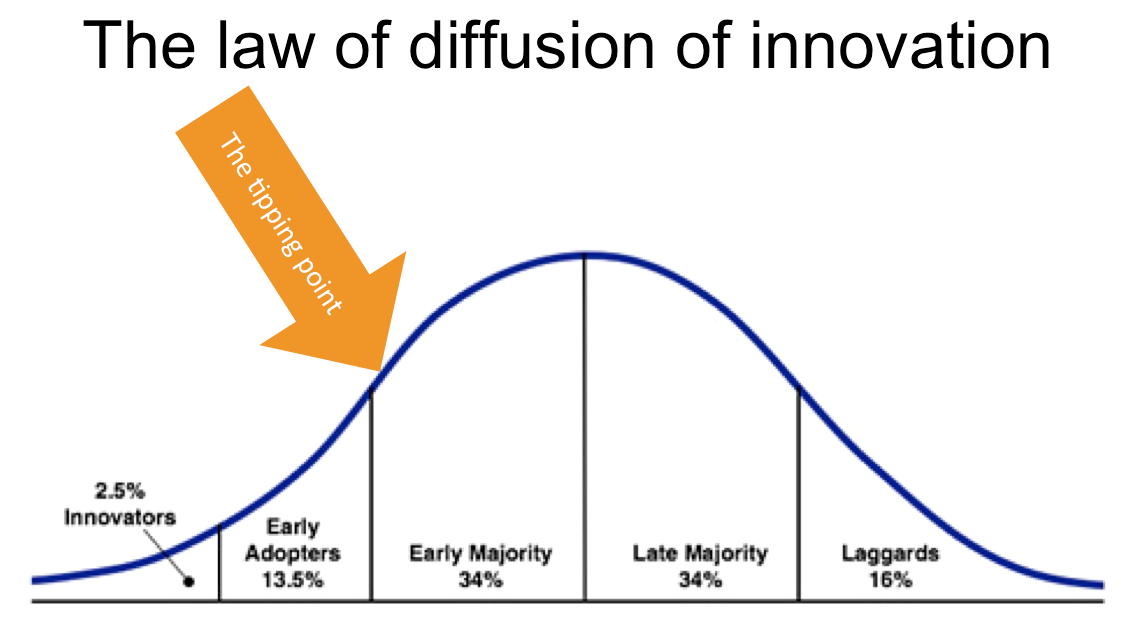
I agree with Wikipedia that this is a theory, not a law. I’m also willing to bet that you’ve been introduced to this general concept in one form or another. A class on statistics, conversations about bell curves, or just anecdotally. Diffusion of Innovations matches how we presume the world works and we see it all the time. Early adopters of electric vehicles, lifestyles, fads, etc. and, conversely, laggards when it comes to cell phones, food, style, etc.
Why the Diffusion of Innovations Matters
Where the light bulb finally went on for me is that this is how you should approach a market(!). I don’t doubt that some of you with better marketing backgrounds are way ahead of me… It took me grad-level marketing courses, and three viewings of Simon Sinek’s How Great Leaders Inspire Action to make this leap:)
How to use the Theory of Diffusion of Innovations: LEDs (again!)
The specific problem I was trying to solve was: How do you market energy efficiency to consumers?
Energy efficiency is a broad topic. Some of the categories are:
- Lighting
- Heating, Ventilation, & Air Conditioning (HVAC)
- Appliances
- Behavior
- Building Science (Design, Materials, Air Sealing, Insulation, etc.)
- So much more…
Each category contains numerous full-time professions(!). Where do you start?
When thinking about energy efficiency and specifically seeing results at the meter, we wanted a few things:
- Low-barrier to entry – Is it the action perceived as easy and affordable?
- Compliance – Will the customer follow through?
- A sense of success – Does the doer feel successful? Will this action help build confidence?
- Trust/leverage – Does the outcome build a relationship between the consumer and the provider (me)?
- Introduction to the next step – How are we building a journey we can travel together?
Knowing this, we chose LED light bulbs as a starting point. To spell out the logic:
- Low-barrier to entry – Is it the action perceived as easy and affordable?
- Yes. LEDs are cheap and relatively easy to find.
- Compliance – Will the customer follow through?
- Yes. LEDs are no more difficult to install than other bulbs.
- A sense of success – Does the doer feel successful? Will this action help build confidence?
- Yes(?). I certainly felt this way. Most people notice changes in light color and quality, even if they do a good job matching bulbs. Longer-term, it’s a safe bet that if you change the majority of light bulbs, you’ll see your electricity bill go down by at least 10%.
- Trust/leverage – Does the outcome build a relationship between the consumer and the provider (me)?
- Yes. We helped this along by making a specific tool to help the installation process (1-page info sheet to help make a shopping list and record where you’re changing bulbs along with a list of local retailers) and recommended highly-rated bulbs. This is a variation on what Ramit Sethi calls the “Briefcase Technique.” We did +80% of the work in advance to help set the consumer up for success.
- Introduction to the next step – How are we building a journey we can travel together?
- Sort of. We conditioned our consumers to make small changes. Most consumers were either passively or actively aware that there are lots of things you can do for energy efficiency.
Recentering on Diffusion of Innovation. LEDs were already on their Diffusion of Innovation curve internationally. The history of LEDs dates back to 1962, and we’ve seen them applied in many ways throughout our lives. Big picture, we’re talking about an established technology with a multitude of applications internationally.
The micro-market of LEDs our team was focusing on was installing LED lighting in residential and commercial buildings. At the time (2014), LEDs light bulbs were finally at a place where they made economic sense and could outperform their competitors, CFL, and incandescent bulbs. More specifically, our goal was to normalize LED light bulbs in peoples homes. To help them migrate from their habit of purchasing and installing CFLs and incandescent bulbs.
Diffusion of Innovations: Target Markets & Focus
The gift of the Diffusion of Innovation is that it helped us focus on the early adopters (~14% of the population) and the early majority (~34% of the population). We started asking ourselves what we could to grease the skids? What were the steps we could take to make it as easy as possible for these two populations to adopt?
I am going to continue to focus on the mindset and strategy and share the specific tactics we used in another post.
Diffusion of Innovation helped us focus. We could make and test assumptions about a specific subpopulation. This correlates well with the frequent entrepreneurship/marketing advice: “find your niche.” Which I interpret to mean, find your toehold and build from there.
More importantly, this mindset scales. We applied it over and over again for each program we launched. LEDs, smart thermostats, rooftop solar PV, behavior change, and even whole home weatherization.
Fundamentally, I see Diffusion of Innovation as an important mental model for establishing a new normal and segmenting your market. Establishing a new normal is critically important to sustainability work. The bulk of sustainability work is change management/culture change/midwifery. Constantly birthing a new future, over-and-over-and-over for everyone you work with. A big part of establishing a “new” normal is communicating as if it is normal. This is a challenge for you. How do you communicate that what you’re proposing is “normal.” Not a pilot. Not a test. Not a hypothetical. Normal.